Carob trees

Remember way back when Megan planted Carob Trees from seed into a two inch soil pot, then moved them to a small plastic planting bag and then finally into the soil at the fence line?  See carob trees from July 2014. The trees are slow growing, but even with our neglect, they are still alive!

carob tree

Look closely, there really is a tree in front of the post.

On average, our Carob are about 7 inches tall. 11 were planted in the garden, 10 are still alive. They are now two years old. Megan and Jon researched wind break trees VERY carefully and Carob were one of the few that were highly wind resistant, grew well in all types of soil, weren’t concerned about excess rain OR drought, and produced animal food. The only drawback was that they were slow growing and did not transplant well so needed to be started from seed for best succes. No one thought that they would be THIS slow to grow. So the back-up plan is to interplant a few of the more fast-growing windbreak options that will be cut down whenever the carob eventually get large enough to be a wind-break. Which could be a while.

Green house structures complete!

YEA all three green house structures are complete!  Each one is 750 square feet of planting space, complete with water access.  Megan has two green houses in the planting process and the third is being fixed as work space as well as a place to start seedlings.  Visible progress!

greenhouse 12

Green house number one is the closest with the door open, with two and three following up the incline.  The planting boxes are stacked outside the door on the right because we are working on the inside.

greenhouse 11

We are putting down the last of our packing paper on the ground and covering it with Tosca to keep the weeds down.  The workbench is in place, and Jon has dug the trench to bury the water line.  It is getting there poco a poco.

Greenhouse Update

As we mentioned earlier, the green house construction has been an ongoing project for awhile.  It has now risen to the top of the to-do list.  With hot dry wind and no water, the solution to keeping some vegetables alive is to get them into a greenhouse.  We have three structures.  They have fiberglass panels on one long wall and the roof, and metal panels for the other long side and the ends.  All the guys have been working diligently to get these completed.

greenhouse 2

greenhouse 3

greenhouse 5

greenhouse 6

greenhouse 7

greenhouse 10

greenhouse 9

The pictures are all of green house number three being completed, the second greenhouse is completed, the first (they are numbered by location, not completion), has half a roof – nearly there!

garden greenhouse

Megan is planting them again.  Green house number one will be the workshop for the garden so she has a place to stage her seedlings and store her tools.  The outside garden plots will grow winter hardy plants and feed for the animals.

Drying Out

This has been a warm summer, one without much rain.  In fact, our February was very hot and very dry and very windy.  The hot dry wind helped dry out our gardens as much as the heat.   It is now March, and we still are having hot dry days.  This should be fall weather but it’s still summer weather.  We have only a garden hose with which to irrigate.  It takes three hours to water each garden bed (so six hours for two beds) and that is with one bed not planted.  It takes three hours to water the pecan trees.  It takes three hours to water the citrus trees.  It takes an hour to water was little was planted in the under-construction greenhouses. So things get watered on a rotation basis.  Let no one forget that this means managing the water tanks so we keep them full enough without pulling so much water from the well that it has a chance to refill.   Then there are the animal troughs to keep filled, the cows drink a lot when it is hot and the sheep too, and the rabbits and chickens need an afternoon water refill also.

Therefore the garden has been drying out and we are harvesting the last of the crop.  It is not just us, the entire community is in the same position. Conversation revolves around who got rain who had the clouds pass over but not drop any water.

Here is our thirsty garden:

garden drying 1

garden drying 2

garden drying 5

garden drying 6

garden drying

Squash and watermelon are our last crops this season.  The next set of crops will be hardy winter plants.

Squash

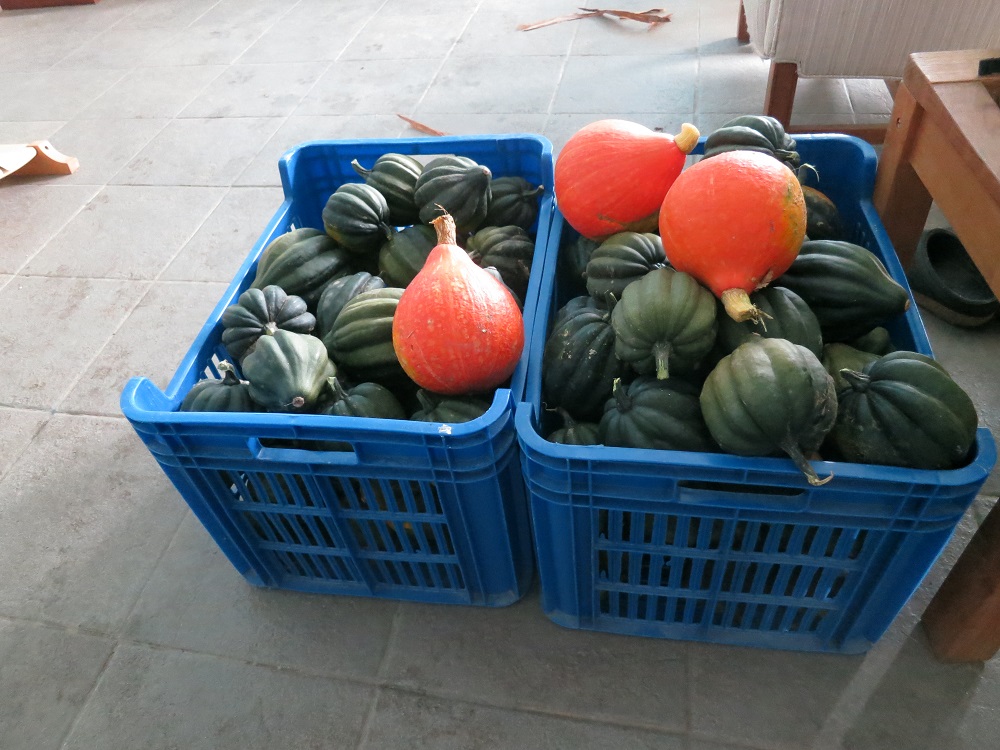
Remember our Squash Beds?  We have several because people in Uruguay like squash.  There is not a lot of variety of squash available in the market, and yet squash is something that stores well, so we knew if we did not eat it all fresh, we could store it for later.  Needless to say, we have yet to have any extra.  We feel special when we get to have squash on our table.

squash 2

squash 3

squash 9

squash 4

squash 5

squash 6

squash 8

Surprise ! A Tomato Lover

Megan went to the garden to pick ripe produce.  We have one tomato plant that is not in a cage, we let it vine on the ground just to see how it would do.  Well, it did ok until:

iguana and tomatoes

This Iguana was laying in the middle of the plant with a tomato in his mouth.  Three more tomato skins surrounded him.  He was so full he did not even move when we approached a second time with the camera.  We did not think about Iguanas eating our garden. And as the neighbors were astounded that an iguana would eat tomatoes we weren’t being ignorant. Nobody would have thought to guard the tomatoes from the iguana!

Tomato update

Our tomato plants have almost reached their expiration date.  We did not manage to finish any green houses so the wind break wall we were counting on was never built.  The cages around the plants worked great, so we were able to harvest a lot more tomatoes than if we had left them to vine on the ground.  However, when a hot wind blows for weeks everything dries out. No matter how much you water. Particularly when you can only water so much by hand. Because, well, the garden is larger than 15 tomato plants.

So here are more tomato pictures than you might like.I’ll begin with a random day of harvest:

tomatoes 6

Jon liked the small yellow pear shaped tomatoes and ate them like grapes.  I preferred the stripped ones that almost had no inside seeds and we stuffed with tuna fish and ate for lunch one day.  The orange tomatoes were soft and were good sliced with olive oil drizzled on top.  The red oval tomatoes were delicious for dicing and cooking.  The black cherry tomatoes were not anything special to taste, just looked different.  Anyway, here are some tomatoes on the vine, mostly green since we had already picked the ripe ones.

tomatoes 1

tomatoes 2

tomatoes 0

tomatoes 3

tomatoes 4

tomatoes 5

Once we had the tomatoes growing and figured out which ones grew well and which ones we liked, Megan began the process of saving seeds for next year.

tomatoes 7 saving seeds

Evidently tomato seed saving is a little more interesting than saving radish seeds. Tomato seeds ferment to break down the gelatinous sack around the seed, then they are rinsed, then left to dry in a warm, non-sunny location. Megan is planning on planting more tomatoes for the greenhouse that isn’t yet build so that we’ll have tomatoes year round. She’s optimistic. Or stubborn. I’m not sure which.

Another Garden Plot

We eventually hope to have eight garden plots planted with both people food and supplemental animal food.  Slowly we are managing to get the plots roto-tilled and rows made and seeds planted.  We have one plot from last year that is again in production this year.  Now we have another plot planted and producing!

garden bed 2 prep

Garden Bed 1

squash a

This plot is eventually (i.e. this coming July) intended to be permanently planted with raspberries. So row spacing, row depth, and walkways were made for that eventuality. As raspberry canes are planted bare root in winter, right now this is the perfect bed for all those heat loving, vining plants. We have acorn squash, tours (a French field pumpkin), three kinds of watermelon, honey dew, musk melon, a few more types of melons, and three more kinds of squash.  Since this is the first year Megan will have planted any of these varietals these plants are sort of the ‘trial garden’ so to speak. She’ll make sure that at least one fruit from each have pure seed. And then, depending on success of the plant, yields, taste, etc. we may or may not ever plant these again. But right now they’re all just green.

We are currently working on the next plot, who knows, we may get TWO plots in production this year!